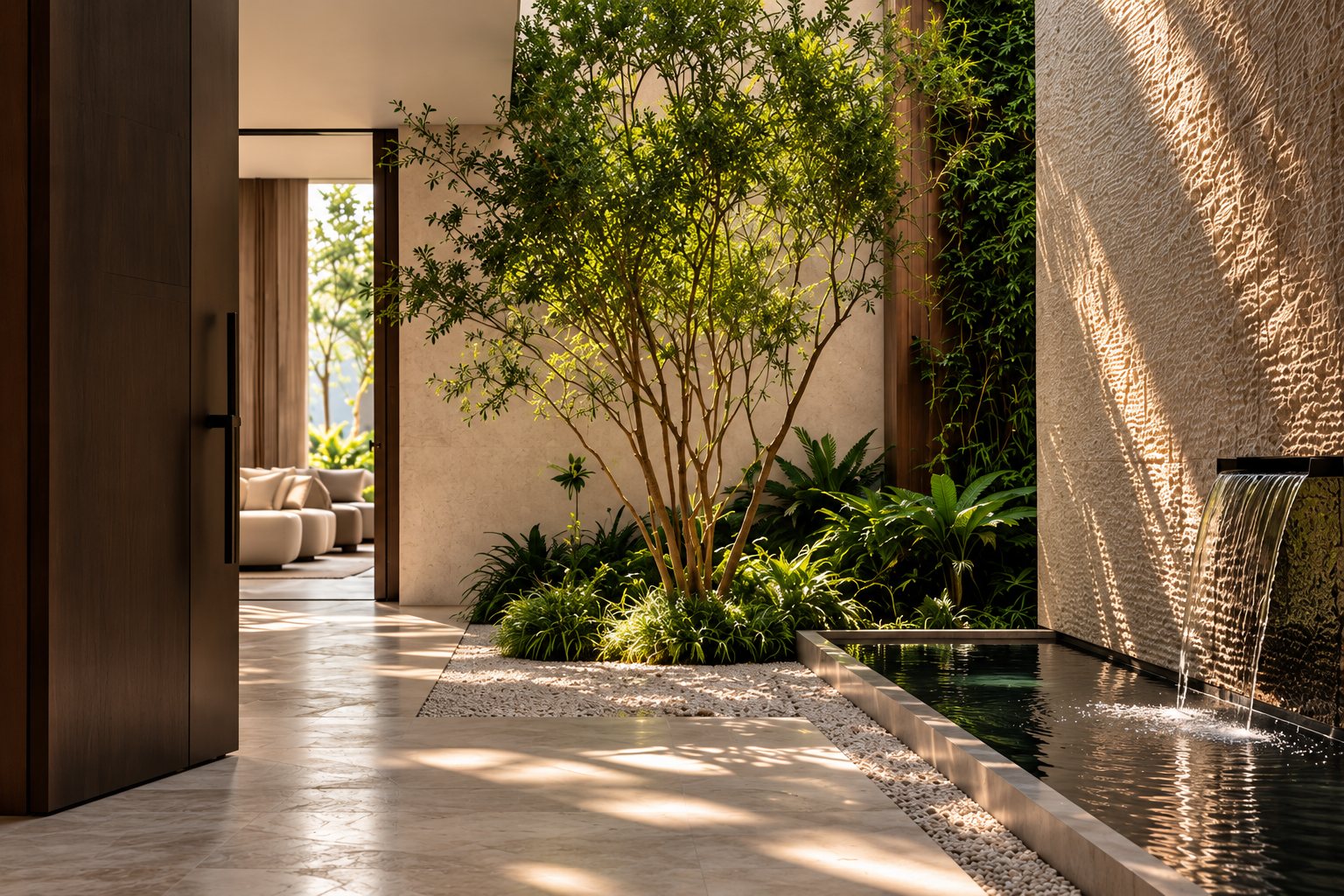
A holiday brings peace for a week. A sanctuary holds it for years.
The calm you seek elsewhere should be waiting at your own front door.
Think of the moment the front door opens at the end of a hard day. The heart is still running fast, the shoulders still set, attention still on a call, a deal, another time zone. What the home offers in the next few minutes decides whether that state begins to ease, or simply carries on indoors.
Biophilia, the term the biologist E.O. Wilson made famous in 1984, is our instinctive pull towards living things. For centuries, homes were built around nature, with courtyards, gardens and open windows that brought light, air and greenery into everyday life. The modern home, sealed, cooled and lit to a single setting, has shut most of that out. Not by design, but by default.
A home can be beautiful, and still give the nervous system nothing to rest on.
Why It MattersThe evidence
In 1984, Roger Ulrich published a landmark study in the journal Science. Among matched patients recovering from surgery, those whose window looked onto trees went home sooner and needed fewer strong painkillers than those facing a brick wall. In 1991, his team showed 120 adults a stressful film, then scenes of either nature or city streets. Those who watched nature calmed faster, their heart rate and muscle tension settling sooner. In 2010, a study across 24 forests in Japan found cortisol, the body’s main stress hormone, up to 16 per cent lower after time in a forest than in a city.
The nervous system
Stress and recovery are governed by two opposing branches of the nervous system. The sympathetic readies the body for pressure, quickening the pulse and sharpening attention. The parasympathetic does the reverse, slowing the heart, deepening the breath and allowing repair. Exposure to natural surroundings is often associated with a shift towards the latter. In the Japanese forest studies, parasympathetic activity rose by more than half. A home that offers none of it leaves the body braced long after the day has ended, waiting for a signal that never comes.
Attention
A day of meetings, calls and decisions wears the mind down. The sway of leaves, light shifting across a wall, the sound of water. Natural patterns like these hold attention without demanding it. Researchers call this soft fascination. It is how focus is restored.
In the Gulf
For much of the year, the outdoors is not an option. Life moves from a closed car to a closed lobby to a closed home. Whatever connection to nature the family has must be designed in deliberately, or it is not there at all.
What It Means in a HomeThe Home Assessment reviews every room against eight conditions, and sets out what to change and what to bring in.
The threshold
The first view from the front door. It sets the pace for all that follows.
Daylight and view
Where the family rests longest. A window onto trees outdoes any object.
Light that follows the day
Bright and cool by morning, low and warm by night, never one setting.
Living materials
Wood, stone, linen, wool. Surfaces that age honestly, not perfectly.
Planting where the eye lands
The bedside, the desk, the end of a corridor. Not only the corners.
Quiet
Equipment hum, measured and reduced, so the home can fall still.
Refuge
One sheltered corner with a view out, where it is possible to stop.
Living water
Water designed as a living system, not managed as a utility. Moving, heard and seen.
Wilson, Biophilia (1984). Ulrich, Science (1984). Ulrich et al., Journal of Environmental Psychology (1991). Kaplan & Kaplan, The Experience of Nature (1989). Park et al., Environmental Health and Preventive Medicine (2010). Connection to nature is also addressed within the WELL Building Standard.